You ask AI a simple question.
“What are the best running shoes?”
The answer mentions:
- Brand A
- Brand B
- Brand C
But not Brand D — even though Brand D:
- ranks #1 in Google
- has massive brand recognition
- dominates SEO for this keyword
This isn't random or a bug — it's a result of how AI systems decide what to include in an answer.
AI Visibility refers to whether — and how — a brand appears in AI-generated answers, not just whether it ranks in search results. (For a foundational overview, see What is AI Visibility?)
To understand AI Visibility, it helps to understand how these systems actually work.
What you'll learn from this article
By the end of this article, you'll understand:
- why AI answers are not built the same way as search results
- how LLMs generate answers and where their limitations come from
- how tools like web search and Retrieval-Augmented Generation (RAG) change what AI can mention
- why the sources AI uses are not identical to Google results
- how brands earn — or lose — a place in AI answers
- why SEO is still important, but no longer the final goal (this builds on concepts introduced in our first article)
LLMs Are Not Search Engines
Large Language Models like ChatGPT work very differently from search engines such as Google or Bing.
Search engines crawl the web, rank pages, and return links. You decide what to read.
LLMs don't do that.
An LLM generates an answer directly. It doesn't fetch live webpages by default — it predicts the next words based on patterns learned during training. Instead of pointing you to documents, it tries to be the document.
This is why AI answers feel more like talking to an expert than browsing search results.
Entities over keywords
Modern AI systems focus on meaning and intent, not exact keyword matches. They understand that “Apple” can refer to a company or a fruit depending on context. Visibility in AI systems is therefore less about repeating keywords and more about being clearly associated with the right entities and topics.
Probabilistic Answers and LLM Limitations
An AI assistant like ChatGPT is not just an LLM.
The LLM is the core of the system — but it's only one part of it.
At the LLM level, answers are generated probabilistically. The model predicts the most likely next words based on patterns learned during training. It doesn't reason like a human, and it doesn't verify facts against a live database.
Because of this, AI answers can vary slightly each time — and in rare cases, even be wrong. The model isn't calculating answers from first principles; it's generating language that sounds correct given the context.
LLMs are also limited by their training data. They can't verify new information and can't invent knowledge beyond what they've seen. When pushed outside those boundaries, they may confidently produce incorrect or made-up information — commonly called hallucinations.
Another critical limitation is time.
LLMs have a fixed knowledge cutoff. Anything published after that date simply doesn't exist for the model unless external tools are used. Without web access, an LLM can't know today's news, the current time, or newly launched brands.
This is why external retrieval matters — and why AI Visibility depends not just on training data, but on what information is available at the moment an answer is generated.
To see this in action, compare how ChatGPT responds to questions about a newer brand (Genwolf) versus an established one (Google) — both without web search enabled:
New brand (Genwolf) without web search:
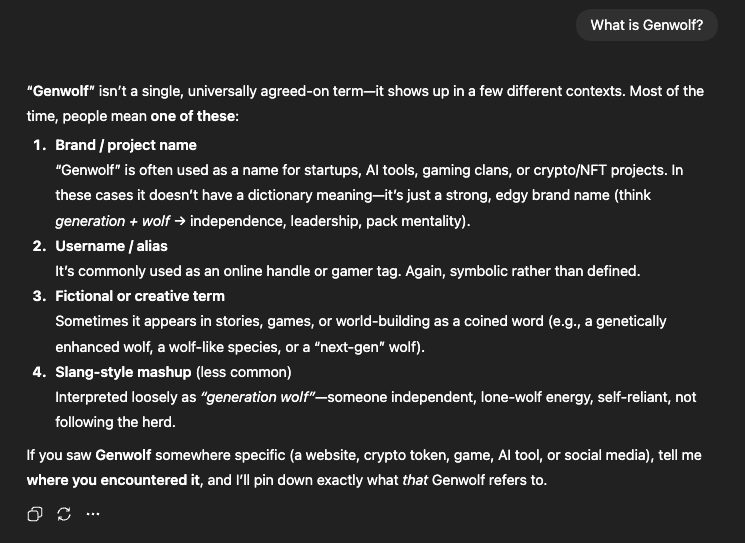
As a newer brand, Genwolf may not be present in the model's training data. Without web search, the AI is unable to provide reliable information.
Established brand (Google) without web search:
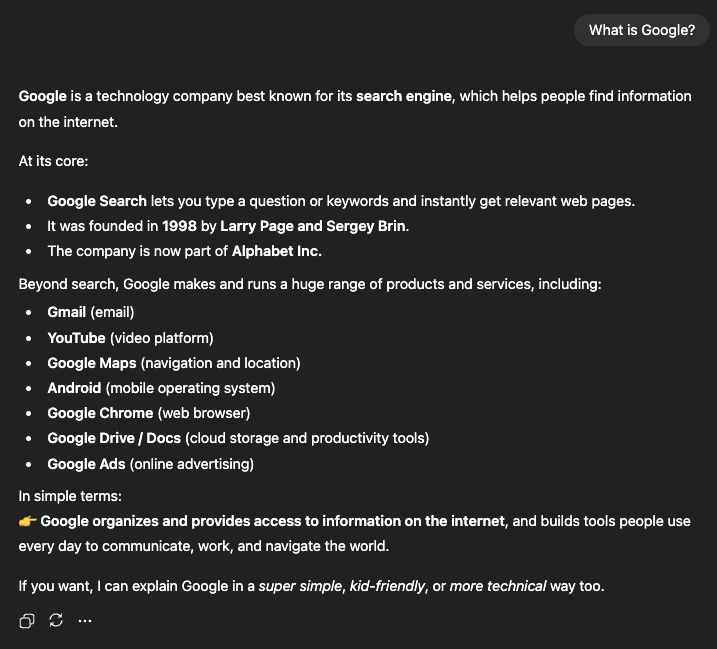
Google is widely represented in publicly available text, so models can usually describe it even without web search.
How ChatGPT (and Others) Use Tools
To overcome the limitations of a standalone LLM, systems like ChatGPT wrap the model in additional tools and software.
This means ChatGPT isn't just generating text from memory. When needed, it can:
- fetch live information
- call external services
- search the web
These tools are not used by default. The system decides whether external information is necessary based on the question.
Simple, timeless questions can be answered directly. Questions that require freshness, precision, or new context may trigger web search.
This is why the same question can produce very different answers depending on whether web search is used.
Some AI tools, like Perplexity, rely on live search by default. Others, including ChatGPT, use web search selectively. As a result, AI answers are built from different source pools, even when the question is identical.
Under the hood, these systems often rely on traditional search indexes (such as Bing or others), but the selection and synthesis of sources happens inside the AI system — not inside the search engine itself.
Here's the same question about Genwolf, but this time with web search enabled — notice how the response changes completely:
New brand (Genwolf) with web search enabled:
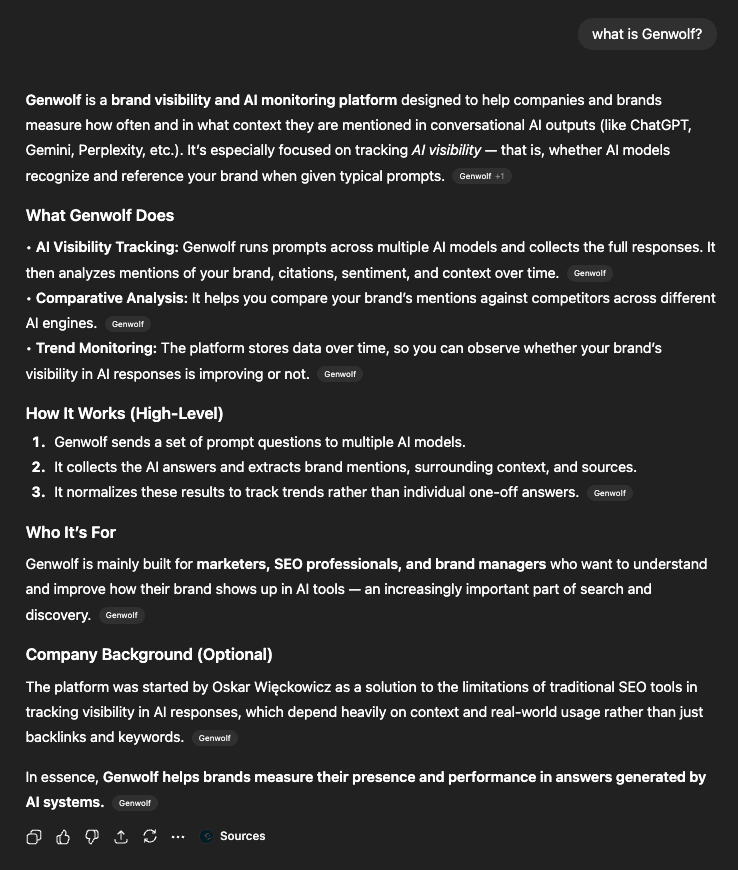
With web search enabled, ChatGPT can now provide information about Genwolf because it retrieves and cites sources from the web, even though the brand is not in its training data.
LLM + Web Search: How Retrieval-Augmented Generation Works
When an AI system decides to use web search, it follows a retrieval-augmented process.
First, it determines whether external information is needed. If so, it sends a query to a search system and retrieves a limited number of relevant sources. It doesn't read the entire web — only a small subset of results, constrained by time and cost.
The retrieved content is then provided to the LLM as additional context. The model combines this information with its existing knowledge, extracting key points and synthesizing them into a single answer. In many cases, the sources are also cited alongside the response.
This architecture is known as Retrieval-Augmented Generation (RAG).
Retrieval-Augmented Generation connects a language model to external sources so it can retrieve live information and integrate it into its answers.
RAG allows AI systems to go beyond their knowledge cutoff and reduces hallucinations by grounding answers in real, up-to-date content. At the same time, the quality of the answer depends directly on the quality of the retrieved sources.
An important consequence follows.
The AI's choice of sources is not neutral. It usually pulls content that search systems already consider relevant and authoritative. If a website is buried deep in search results, the AI is unlikely to ever read it.
However, the retrieved source pool is not a one-to-one copy of Google results.
AI systems may rely on different search providers, different indexes, and different ranking signals. Even when the same content exists, the order, selection, and weighting of sources can differ significantly.
As a result, a brand can rank highly in Google and still be missing from AI answers — while another source, less visible in Google, becomes part of the AI's response.
The following comparison illustrates this gap. We searched for “best email marketing tools” in both Google and ChatGPT, and tracked which brands appeared in each:
Google search results for “best email marketing tools”:
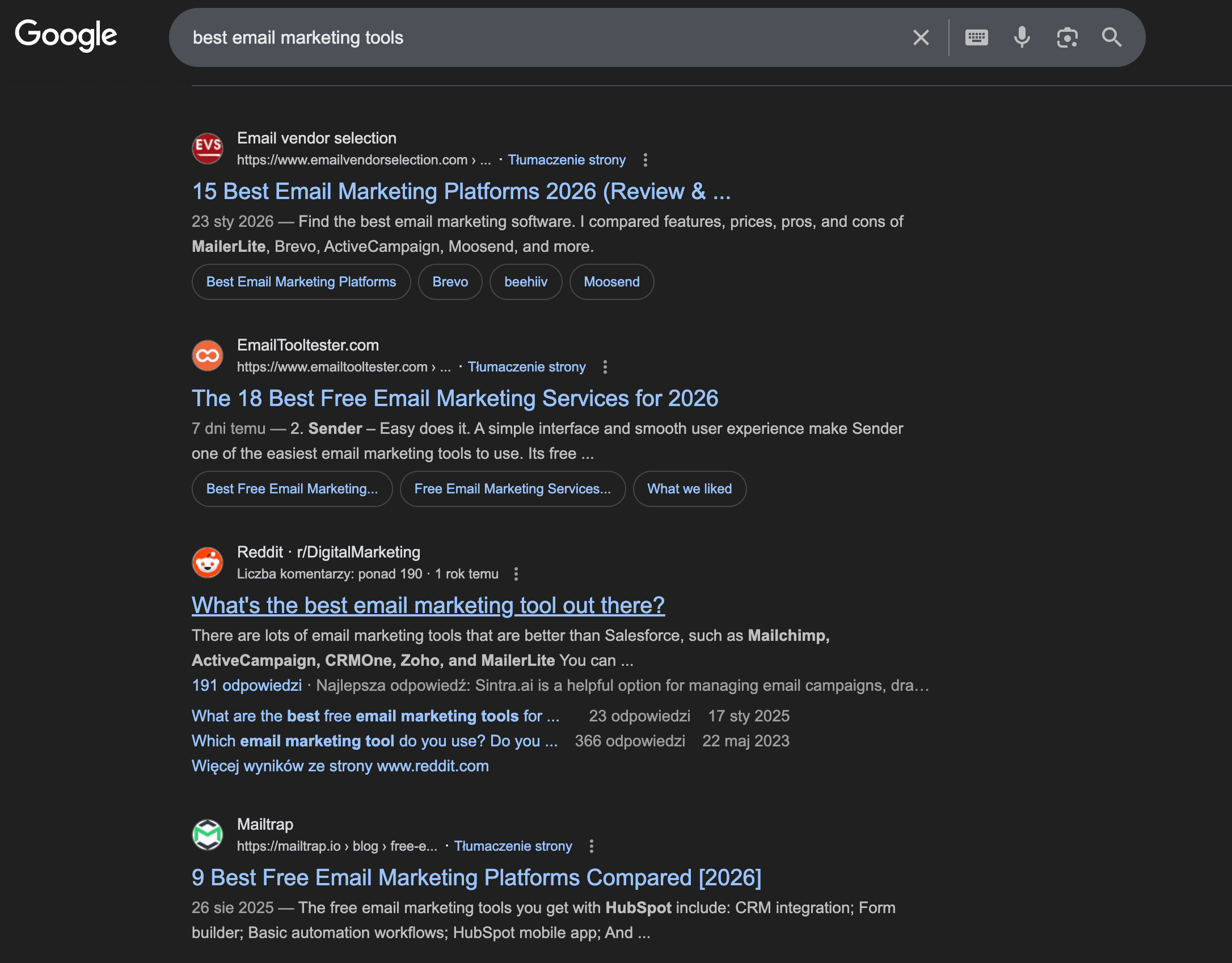
Mailtrap.io appears on the first page of Google results (position #4 in this snapshot) with a ranking page that promotes their own tool.Snapshot taken on Feb 1, 2026 (location: PL)
Now let's see how ChatGPT answers the same question:
ChatGPT response to “What are the best email marketing tools?”:
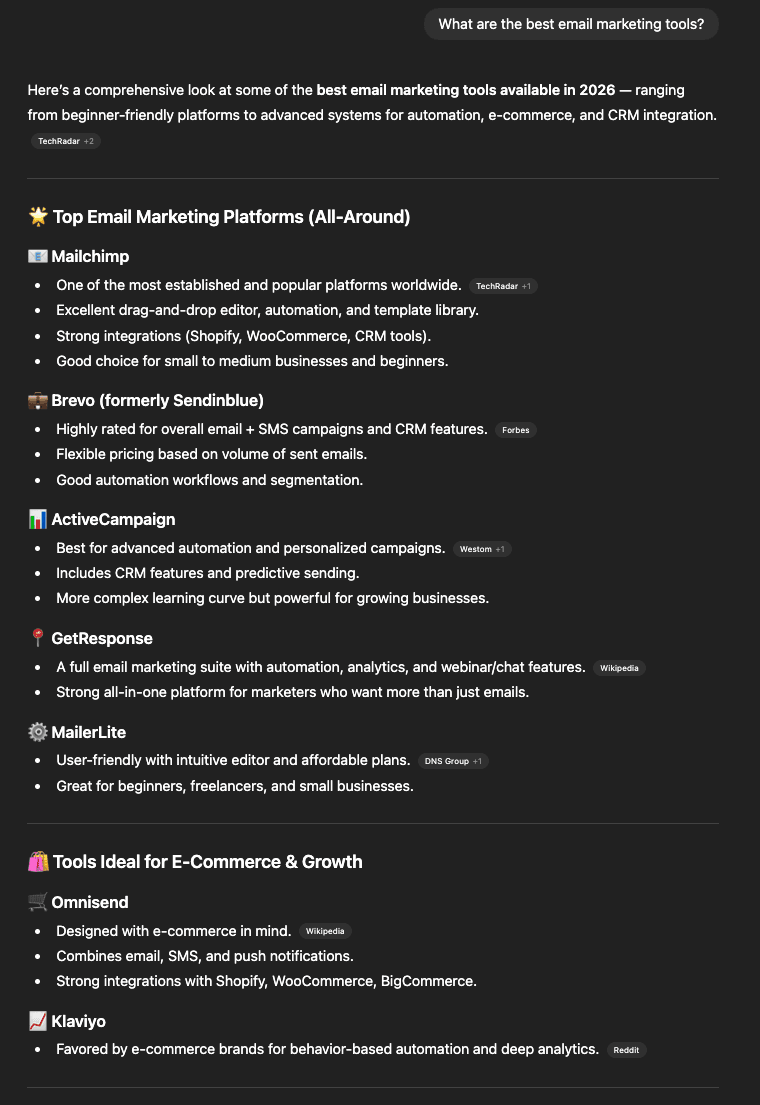

Despite appearing on the first page of Google (position #4), Mailtrap.io is not mentioned in ChatGPT's answer. This demonstrates how AI source selection differs from search engine rankings.Snapshot taken on Feb 1, 2026 (location: PL)
How Brands Earn a Place in AI Answers
So how do AI systems actually decide which brands to mention — and which ones to ignore?
They don't choose brands directly.
They choose sources.
The source pool is the limited set of documents and information an AI system retrieves and considers when generating an answer.
Whether a brand appears in an AI answer depends on several overlapping signals.
One is training data presence. Brands that appeared frequently in the model's training data may already be recognized and mentioned from memory. Newer brands or poorly documented ones don't exist for the model unless they appear in retrieved sources.
Another signal is retrieval visibility. SEO still matters here — not as a goal, but as a gateway. If content isn't indexed or discoverable at all, it cannot be retrieved. But visibility alone doesn't guarantee inclusion.
What happens next is selection.
AI systems scan retrieved content to find material that is easy to reuse when constructing an answer. Pages that state the answer clearly, early, and in a structured way are far more likely to be selected than pages that bury the point under long introductions.
In practice, a brand is mentioned in AI answers only if:
- it exists in the model's training data or
- it appears in retrieved sources and
- its content is clear, extractable, and relevant
Authority and trust signals further influence selection. AI systems tend to rely on sources that are frequently cited and consistent with others. Freshness also matters: recently updated content is often preferred for time-sensitive queries.
Finally, format and specificity play a role. FAQs, lists, comparisons, and clearly labeled sections are easier for AI to reuse than broad, generic articles.
Taken together, these signals explain why AI answers vary between models and change over time. As content evolves, the source pool shifts. A brand mentioned today may disappear tomorrow — not because it got worse, but because stronger or clearer signals replaced it.
This is where AI Visibility truly begins.
SEO influences whether content is retrievable.
AI Visibility determines whether that content is actually used in the answer.
In short
- AI answers are built from retrieved sources, not rankings.
- The source pool is not identical to Google search results.
- SEO affects retrieval; AI Visibility affects selection.
- If a brand is not in the source pool, it cannot be mentioned.
Closing thought
AI Visibility isn't about tricks or hacks.
It's about understanding how answers are assembled.
Once you realize that AI systems don't rank pages — they construct responses from a shifting set of sources — the problem becomes clear.
And so does the opportunity.
Brands that learn how to observe, measure, and adapt to this new layer of visibility won't just rank well. If you want to start tracking your brand's presence in AI answers, see How to Track AI Visibility?
They'll become part of the answer.