AI Visibility refers to the extent to which a brand appears in responses generated by artificial intelligence systems.
Simply put, it describes whether and how a brand is mentioned by tools like ChatGPT, Gemini, or Perplexity — either directly in the response text or as a cited source.
AI Visibility describes how often, in what context, and based on which sources a brand appears in AI-generated responses.
What you'll learn in this article
In this article:
- we explain what AI Visibility is
- show why it matters today
- use simple analogies to explain how it works
- answer whether AI Visibility can be measured and influenced
This article explains what AI Visibility is and why it matters.
It does not cover the technical inner workings of AI systems — for that, see Why does AI mention some brands and completely ignore others?
What does AI Visibility consist of?
AI Visibility is mainly made up of two elements:
- mentions – direct references to a brand in the response text
- citations – cases where a brand is referenced as a source of information
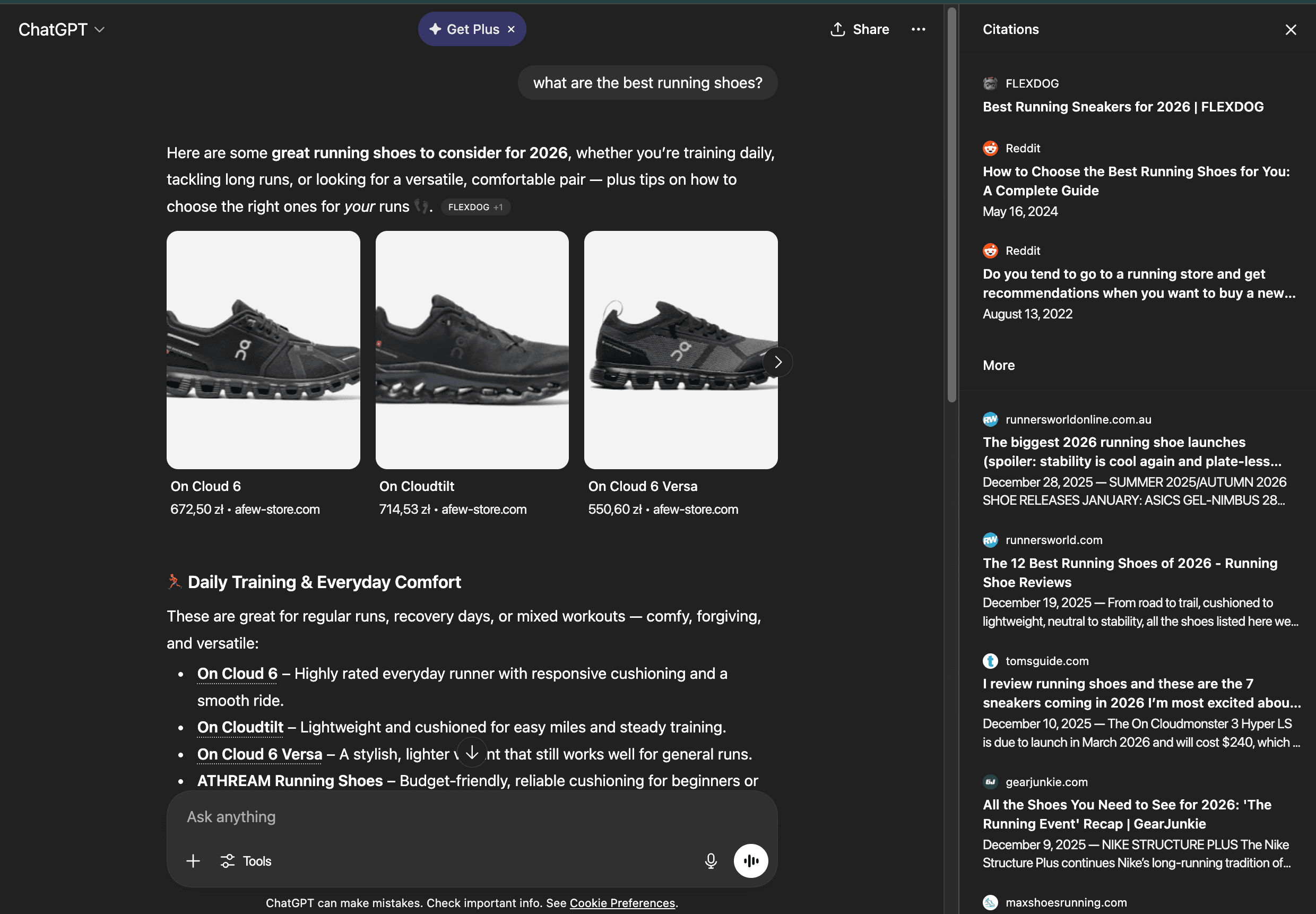
What is a brand mention vs a citation in an AI response:
In the main AI answer, product and brand names such as On Cloud 6, On Cloudtilt, and On Cloud 6 Versa appear directly in the response — these are brand mentions.
In the citations panel, external pages like brand blogs, review sites, and community discussions (e.g. Reddit threads or running shoe review articles) are listed as sources — these are citations that support the generated answer.
If a brand appears neither in the response text nor as a source, then from the user's perspective, it effectively does not exist.
Why does AI Visibility matter today?
In recent years, the way people search for information has clearly changed.
More and more users ask questions directly to AI assistants instead of typing them into Google.
According to a 2025 consumer adoption report by Attest, nearly half of respondents said they are likely to use generative AI tools such as ChatGPT to research products before making a purchase. (Source: Attest – Consumer Adoption of AI Report, 2025)
For many people, AI has become:
- the first step in research
- a shortcut to answers
- a filter before making decisions
This shift has led to extreme opinions.
On one side, you hear claims that SEO is dead and everything is moving to AI.
On the other, that AI is just hype with no real commercial impact.
As usual, the truth lies somewhere in between.
AI Visibility does not replace existing channels, but becomes another layer through which users discover brands and products.
To understand this shift properly, it helps to step back.
Stepping back to understand the change
Let's imagine the process of buying running shoes.
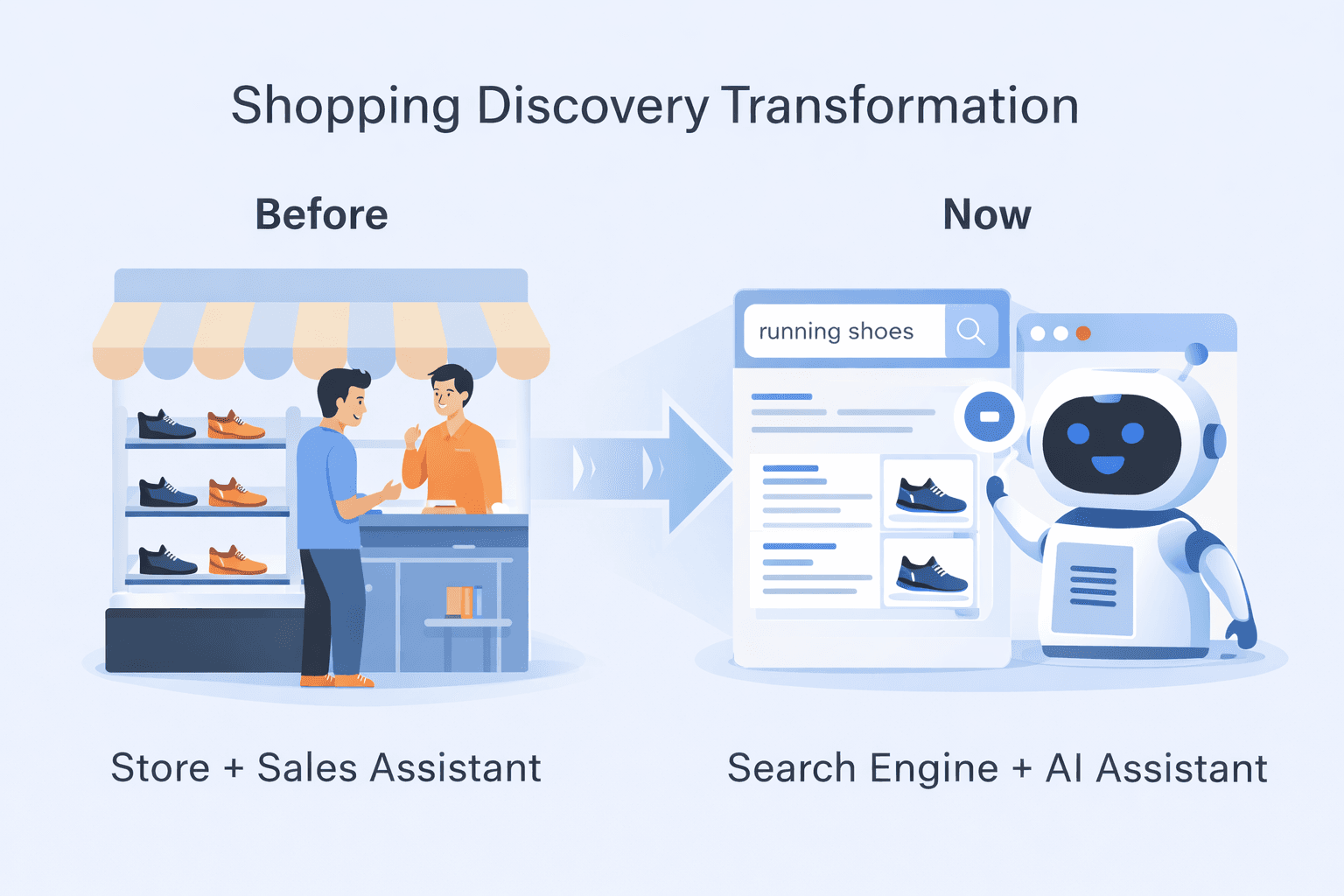
Before the internet
Fifty years ago, there were no search engines or online stores.
People went to physical shops and chose from what was available on shelves.
Decisions were influenced by:
- whether the product was available
- where it was placed on the shelf
- how prominently it was displayed
Products placed at eye level or in featured spots had a much higher chance of being chosen.
These mechanisms still exist today.
The role of the physical sales assistant
In addition to shelves, there was another crucial element: the salesperson.
A physical assistant:
- knew the store's inventory
- asked questions
- understood customer needs
- recommended specific products
Their knowledge came from:
- experience
- conversations with colleagues
- manufacturer materials
- customer feedback
They didn't invent products — they selected from what was available, based on context.
The rise of the internet and search engines
The internet did not eliminate physical stores — it changed the decision-making process.
Digital equivalents have appeared:
- store → search engine
- "Running" shelf → search results for "running shoes"
New sources of knowledge appeared:
- blogs
- forums
- guides
- user reviews
Used not only by customers, but by salespeople as well.
AI assistants as the next stage
Today, we see another step: AI assistants as a digital salesperson.
Users:
- describe their needs
- ask questions
- receive structured answers
- get brand or product recommendations
AI assistants behave similarly to in-store salespeople:
- they don't create brands from nothing
- they don't recommend what they don't "know"
- they select from available information
The difference is scale.
A salesperson helps one person at a time.
An AI assistant responds to thousands simultaneously.
This is where AI Visibility becomes relevant.
In practice, this means AI systems surface brands based on patterns present in their data and the context of the user's query.
What follows from this analogy?
- salespeople did not eliminate shelves
- search engines did not eliminate stores
- e-commerce did not eliminate offline shopping
Likewise, AI does not eliminate SEO, but changes the interface through which information is accessed.
From an AI perspective:
- shelves are knowledge sources
- exposure is brand presence in data
- recommendations are generated responses
Brands still need to:
- exist online
- be described
- be referenced in relevant contexts
Only the interface has changed.
Can AI Visibility be influenced?
In the offline world, companies have long known that:
- sales recommendations can be measured
- contexts of recommendations can be analyzed
- recommendation behavior can be influenced
What a physical salesperson recommends can be measured and shaped.
The same applies to AI systems
AI assistants also:
- surface some brands more often than others
- do so in specific contexts
- rely on available knowledge sources
Measuring AI Visibility means systematically analyzing how often, in what context, and based on which sources a brand appears in AI-generated responses.
Common misconceptions
❌ AI Visibility replaces SEO
✔️ SEO remains a foundation, but it is no longer the only signal.
❌ AI Visibility cannot be influenced
✔️ It can be measured and deliberately shaped.
Why measurement matters
Without measurement:
- you guess
- you act on intuition
- you miss changes over time
Measurement allows you to:
- understand how AI systems "see" your brand
- compare visibility across brands
- make informed decisions
SEO remains the foundation of AI Visibility,
but SEO alone is no longer enough to understand how brands appear in AI-generated responses. Brands with strong SEO visibility are more likely to be mentioned in AI-generated responses, but high search rankings alone do not guarantee inclusion.
FAQ
What is AI visibility?
AI visibility describes whether and how a brand appears in AI-generated responses, either as a mention or as a cited source.
Is AI visibility the same as SEO?
No. SEO is a foundation, but AI visibility also depends on how brands appear across multiple sources and contexts used by AI systems.
Can AI visibility be measured?
Yes. AI visibility can be measured by analyzing brand mentions, citations, and the contexts in which brands appear in AI-generated responses.