At its core, a share of voice calculator is a simple tool—often just a spreadsheet—that measures your brand's visibility against your competitors. It all boils down to a basic formula: (Your Brand's Metric / Total Market Metric) × 100. This turns raw data like search traffic, ad impressions, or social media mentions into a clear percentage showing how much of the conversation you actually own.
Why Building a Share of Voice Calculator Matters Now

Share of Voice (SOV) has evolved far beyond its old-school roots in tracking ad spend. Today, it's one of the strongest predictors of future market share and a direct reflection of your brand's health. And while plenty of sophisticated tools can do the math for you, building your own share of voice calculator is a fundamental exercise every marketer should go through.
Why? Because it forces you to get your hands dirty and define what visibility truly means for your brand.
This hands-on approach pulls back the curtain on the metrics that matter. Instead of trusting a black-box tool, you'll understand the mechanics behind your brand's presence in search, on social media, and—critically—in the new world of AI-powered answers.
From Vanity Metric to Strategic Predictor
For years, SOV got a bad rap as a vanity metric. But extensive research has proven a direct link between a brand's share of voice and its market share growth. When your SOV is higher than your market share, a state known as Excess Share of Voice (eSOV), it's a strong signal that your sales and customer base are about to grow.
Suddenly, your simple spreadsheet is much more than a measurement tool; it's a forecasting instrument. By tracking SOV, you can:
- Justify Marketing Budgets: Show leadership exactly how your content and PR efforts are capturing more of the market conversation than your rivals.
- Guide Competitive Strategy: See which competitors are gaining ground and where they're winning the conversation, so you can react before it's too late.
- Diagnose Channel Weaknesses: Pinpoint if you're crushing it on social media but are practically invisible in organic search, or vice versa.
The Rise of AI Visibility in SOV
The digital world is shifting under our feet again. Conversations that once started on Google are now beginning with AI assistants like ChatGPT, Gemini, and Perplexity. A modern share of voice calculator must account for this emerging channel.
Manually tracking how often your brand gets mentioned in AI answers is impossible. You need a systematic way to understand how often your brand—and your competitors—are cited in AI-generated responses. This new layer of SOV is critical for future-proofing your brand.
Calculating your presence in AI answers reveals how your existing content and digital footprint are influencing the next generation of discovery. You can learn more about measuring and improving your presence in this new arena by exploring the concept of AI Visibility. This guide will give you the foundational steps to build a calculator that brings this vital new metric into the fold.
Defining Your Modern Visibility Landscape

Before you can even think about building a share of voice calculator, you need to define the battlefield. The old idea of ‘voice’ as just a measure of ad spend or media mentions is gone. Today, it's a reflection of your brand's total presence across every channel where customers discover, discuss, and decide.
A modern SOV calculation starts with a clear map of this environment. First things first: who are you really up against?
Your direct sales competitors might not be your biggest rivals for attention. Your true competitors are any brands vying for the same keywords, social media conversations, and AI-generated answers that your audience sees.
For example, a project management software company obviously competes with Asana and Trello for customers. But in the battle for visibility, they're also competing with productivity blogs like Lifehacker or tech publications like TechCrunch for top search rankings. Your SOV competitor list has to include both.
The Three Pillars of Modern Voice
I've found that a truly comprehensive share of voice calculation rests on three distinct pillars. Each one is a critical arena where brand visibility is won or lost. Your calculator has to pull data from all three to give you the real picture.
- Search SOV: This is the classic measure of your organic search presence. It's not about ranking for your brand name, but your visibility for the core, unbranded keywords that drive discovery. You're looking at metrics like keyword impressions, organic clicks, and click-through rate (CTR) compared to the total search volume for those terms.
- Social SOV: This pillar tracks your brand's resonance in the social sphere. Forget follower counts. This is about the volume of mentions, actual engagement (likes, shares, comments), and the overall sentiment around your brand versus your competitors on platforms like LinkedIn, X (formerly Twitter), and Instagram.
- AI SOV: This is the newest—and arguably the most critical—frontier. It measures how often models like ChatGPT and Gemini cite or mention your brand when answering relevant user prompts. Low visibility here means you're invisible to a huge, growing segment of users right at the start of their journey.
A common mistake is to over-index on one pillar while ignoring the others. I've seen brands with amazing Social SOV and tons of engagement who were completely absent from critical search results or AI answers. That creates a massive blind spot in their strategy.
Mapping Your Keywords and Platforms
With your pillars and competitors defined, the final step is to pinpoint the specific keywords and platforms that actually matter. This isn't about tracking every possible term. You need to focus on the ones that signal commercial intent or real influence.
Create a master list that will feed your calculator. For a B2B SaaS company, this might look something like this:
- High-Intent Keywords: “best crm for small business,” “hubspot alternatives”
- Problem-Aware Keywords: “how to improve sales pipeline,” “lead tracking spreadsheet”
- Key Social Platforms: LinkedIn for industry discussions, X for real-time news.
This curated list of competitors, channels, and keywords is the foundation of your visibility map. It ensures your share of voice calculator measures what truly moves the needle, transforming it from a simple metric into a strategic guide.
Getting and Cleaning Your Data for an Accurate SOV
Any share of voice calculator is only as good as the data you put into it. Honestly, this is where the real work begins—turning a mess of raw metrics from different platforms into a clean, comparable dataset that actually tells you something useful.
Your mission is to round up the right numbers for your brand and your key competitors across your main visibility pillars: search, social, and AI.
For search, your best friend is Google Search Console. You'll want to export impression data for the non-branded keywords you care about. Over on social media, you'll use a listening tool to get a count of brand mentions over a specific time. And for AI, you'll need a system to track how often your brand gets mentioned in answers from models like ChatGPT.
Collecting the Right Metrics
The first part is just pulling the data from your tools. The most important thing here is consistency. Make sure you're using the exact same date range for every source and every competitor. No exceptions.
Here's a quick rundown of what you'll need from each pillar:
- Search SOV: Grab the total impressions from Google Search Console for your tracked keyword list. You can also lean on SEO tools to get a decent estimate of competitor impressions for those same keywords.
- Social SOV: Export the total number of brand mentions from your social listening platform. Remember to apply the same filters (like language or country) for every single brand you're tracking.
- AI SOV: This can be the most manual piece of the puzzle if you don't have a dedicated tool. It involves running your target prompts through different AI models and carefully logging every time your brand—and your competitors'—shows up.
Once you've gathered everything, your raw data might look something like this in a spreadsheet:
| Brand | Search Impressions | Social Mentions | AI Citations |
|---|---|---|---|
| Your Brand | 85,000 | 450 | 12 |
| Competitor A | 120,000 | 600 | 25 |
| Competitor B | 60,000 | 200 | 5 |
The Critical Step: Normalizing Your Data
Take a look at the raw numbers in that table. A problem jumps out immediately, right? The 85,000 search impressions are on a completely different scale than the 12 AI citations.
If you just mash them together, search impressions will completely dominate your final SOV score, making the other channels almost irrelevant. That's not an accurate picture of your visibility. This is where data normalization saves the day.
Normalization is just a fancy term for adjusting values measured on different scales so you can compare them fairly. It stops a high-volume metric (like impressions) from drowning out a lower-volume but incredibly important one (like an AI citation). If you want to go deeper on valuing these different touchpoints, you can learn more about tracking brand mentions and citations.
The core idea is to level the playing field. You're not comparing raw impressions to raw mentions; you're comparing your share of impressions to your share of mentions. This ensures each channel contributes fairly to your overall visibility score.
A straightforward way to normalize is to turn each metric into a percentage of the total for that channel.
Let's use our social mentions as an example. The total mentions in the market are 1,250 (450 + 600 + 200). So, your brand's normalized score for social is (450 / 1,250), which equals 36%.
You'd then do the same for search impressions and AI citations. Suddenly, you have three comparable percentages ready to be weighted and plugged into your final calculator. This cleaning process is arguably the most important step. Skip it, and you're almost guaranteed to end up with misleading insights.
Alright, you've gathered your data, cleaned it up, and you're ready to actually build your share of voice calculator.
The engine that drives this whole thing is a surprisingly simple formula. At its core, the calculation is always the same, whether you're looking at search impressions or AI citations:
(Your Brand's Metric / Total Market Metric) × 100
This turns all those raw numbers into a clean percentage, showing you exactly how much of the conversation you actually own. Let's walk through how to build this out in a basic spreadsheet, like Google Sheets or Excel, using a real-world scenario.
Imagine you're a SaaS company trying to figure out your total visibility against three main competitors. Your goal is to combine search, social, and AI data into a single, master “Total Visibility SOV” score.
The trick is to calculate the SOV for each channel on its own first, before you try to roll them all up together.
This simple workflow shows how you should prepare your data before it ever touches a formula.
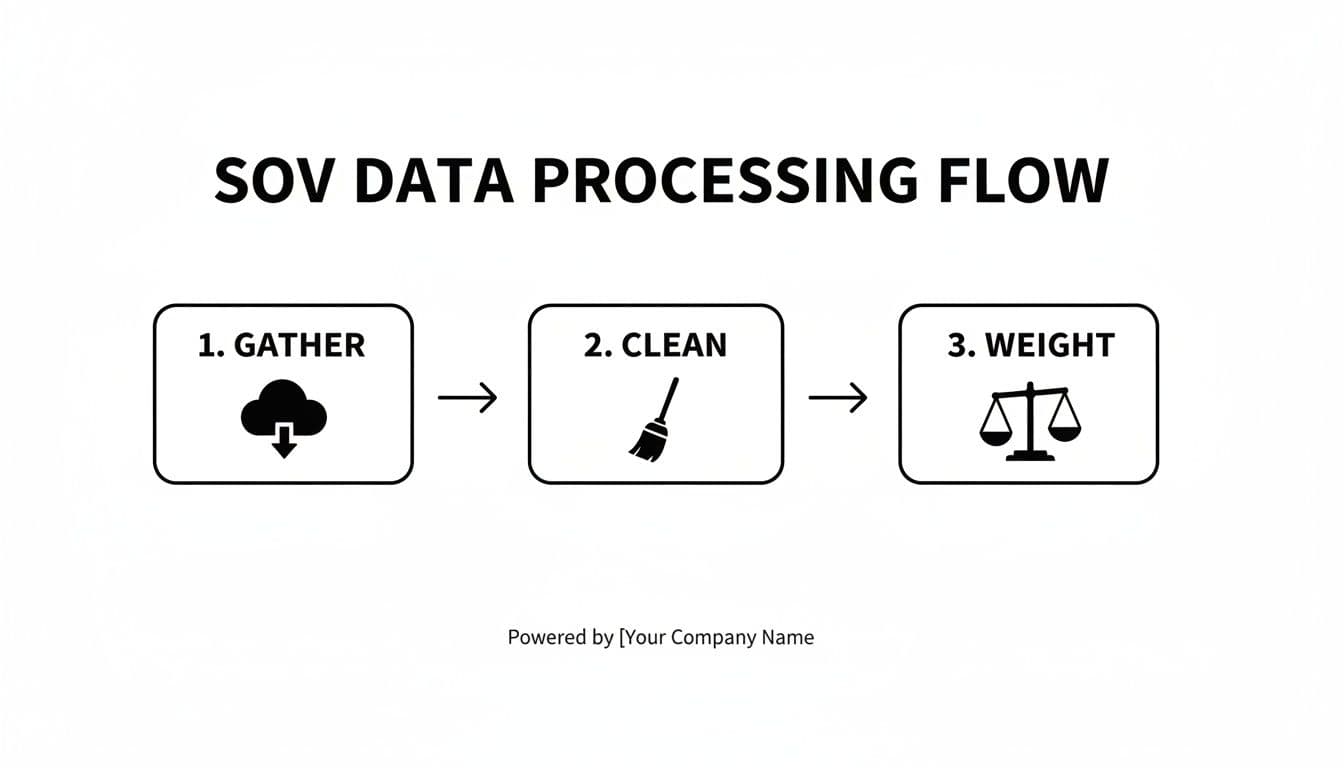
Following this process makes sure every data point is comparable and ready to go, which prevents a lot of headaches later on.
Setting Up Your Spreadsheet Calculator
Start by setting up columns for each competitor and each channel you're tracking. Let's use social media mentions as a quick example.
Say your SaaS brand earned 500 mentions last month across platforms like X (formerly Twitter) and LinkedIn. Meanwhile, your competitors pulled in 300, 450, and 250 mentions respectively. That gives you a total market conversation of 1,500 mentions.
Your social SOV is (500 / 1,500) × 100, which works out to 33.33%. It's a metric that started in 1960s advertising but found new life in the digital world as social media exploded. You can read more on the history and modern use of SOV if you're curious.
Now, here's how to structure your spreadsheet to calculate a weighted, total SOV:
- Input Raw Data: Create a section where you can plug in the raw, normalized numbers you collected (like impressions, mentions, or citations).
- Assign Weights: Let's be honest, not all channels are created equal. You might decide organic search is twice as important to your business as social media chatter. So, you assign a weight to each channel (e.g., Search = 0.5, Social = 0.25, AI = 0.25). Just make sure they all add up to 1 (or 100%).
- Calculate Weighted Scores: For each brand, multiply their individual channel SOV percentage by the weight you assigned to that channel.
- Sum for Total SOV: Finally, add up the weighted scores for each brand. That gives you their final, all-encompassing “Total Visibility SOV.”
This weighting step is what makes the calculator truly yours. It lets you align the SOV calculation with what your business actually cares about. If winning organic search is your top priority, give it a higher weight. Simple as that.
Taking It a Step Further with Excess Share of Voice
Your calculator is already useful, but you can make it even more strategic by adding one last calculation: Excess Share of Voice (eSOV).
This metric is powerful because it compares your visibility to your actual slice of the market. The formula is:
eSOV = Your SOV (%) − Your Market Share (%)
For instance, if your Total Visibility SOV is 25% but your current market share is only 15%, you have an eSOV of +10 points. That's a fantastic leading indicator of growth. It shows your marketing is punching above its weight, which often comes before a real increase in sales and market share.
By adding eSOV, you turn your calculator from a simple measurement tool into a genuine strategic asset that can help you forecast where your brand is headed.
From Manual to Automated: The AI SOV Frontier
A manual share of voice calculator is a fantastic starting point. It gives you a tangible, hands-on feel for where your brand stands. But let's be honest: once you see its value, the manual data gathering quickly becomes a major time sink—especially when you start tracking the new frontier of AI mentions.
This is where automation stops being a luxury and becomes essential. Instead of losing hours manually feeding prompts into AI assistants, logging results in a spreadsheet, and squinting at the numbers to find a trend, you can put the whole process on autopilot. Specialized tools turn that periodic snapshot into a live, dynamic view of your brand's presence in AI conversations.
Platforms like Genwolf are built for exactly this challenge. They automate the work of querying models like ChatGPT, Gemini, and Perplexity to catch every single mention of your brand and your competitors. This forms the real backbone of your “AI SOV” metric.
From Just Measuring to Actively Influencing
True automation moves you from simply measuring your share of voice to actively shaping it. The most powerful AI visibility platforms don't just tell you if you were mentioned; they show you why. They do this by identifying the upstream sources—the specific blog posts, forum discussions, news articles, and product reviews—that AI models cite when they build their answers.
This insight is a complete game-changer. All of a sudden, your marketing team has a clear, actionable roadmap. If a competitor is consistently cited because of a particular industry report, your content team now has a direct target: create a better, more comprehensive report that earns that citation instead.
You're no longer guessing what influences the AI. You have a direct, data-backed link between the content on the web and the answers users receive. This empowers you to build a proactive PR and content strategy aimed at influencing the AI's “brain.”
This strategic layer is what separates basic monitoring from true AI visibility optimization. It's the difference between watching the scoreboard and actually getting in the game.
The New Precision Needed for AI SOV
The shift to AI-driven answers demands a whole new level of precision. By 2026, we'll see share of voice calculators that have evolved dramatically, with tools routinely querying ChatGPT, Perplexity, and Gemini to reveal how often your brand surfaces in awareness-stage queries like “top AI visibility platforms”.
The old SOV formulas—(your mentions / total mentions) × 100—once showed Apple's 31% dominance in the tech world, but that's too simple for today's context. For Genwolf's audience, this means auditing specific prompts. If you find Gemini favors your rivals in 65% of responses for “SaaS growth tools”, it's a clear signal to tweak your PR and content to be more citable.
While some tools automate this with APIs, open-source engines are also emerging to ensure the process is auditable and trustworthy. You can find more insights on HubSpot's blog as these AEO strategies continue to evolve.
Manual vs Automated AI SOV Tracking
While you can start tracking your AI Share of Voice manually with a simple spreadsheet, the limitations become apparent very quickly. The real strategic value comes from automating the process to get consistent, reliable data at scale.
| Feature | Manual Tracking (Spreadsheet) | Automated Tracking (Genwolf) |
|---|---|---|
| Process | Manually run prompts, copy/paste results, and tag mentions. | Automated, continuous prompt execution across multiple AI models. |
| Data Quality | Small, inconsistent sample sizes. Prone to human error and bias. | Large-scale, statistically significant data. Consistent and objective. |
| Source Analysis | Very difficult; requires manually clicking and analyzing every cited source. | Automatically identifies and analyzes the upstream sources influencing the AI. |
| Strategic Value | Provides a basic snapshot. Good for initial validation. | Delivers actionable insights for content and PR strategy to influence AI. |
A manual approach is a great way to get your feet wet, but to truly compete and shape how AI perceives your brand, automation is the only way forward. It's how you move from observing your visibility to actively improving it.
Choosing the right tool is key. For marketers who need a complete solution for tracking and influencing their presence in AI-generated answers, check out our guide on the best AI visibility tools available today. These platforms provide the automation and source analysis needed to not only measure your AI share of voice but to strategically increase it.
Turning SOV Into Competitive Advantage
Alright, let's get into what really matters: turning all those numbers and charts into a competitive advantage. Calculating your share of voice is a great first step, but a number sitting in a spreadsheet doesn't do much on its own. The real value is in what you do with that information.
Think of your SOV results as a diagnostic tool for your marketing. It's a roadmap showing exactly where to focus your efforts for the biggest impact.
For example, what if you discover you have a huge SOV on social media but you're practically invisible in search? That tells you something important. Your brand is great at starting conversations, but you're failing to capture people who are actively looking for a solution like yours. That's a clear signal for your content team: it's time to build out SEO-focused content that answers those high-intent search queries.
Or maybe your brand's AI SOV is lagging behind. The immediate action is just as clear. You need to figure out which specific sources AI assistants like ChatGPT and Gemini are citing when they recommend your competitors. Once you have that list, you can build a targeted PR and content plan to create better, more authoritative content and start winning those citations to shape future AI responses.
Translating Trends into Strategy
Your SOV data becomes truly powerful when you track it over time. A single calculation is just a snapshot. But tracking it monthly or quarterly reveals the story of your market. Is a competitor starting to gain ground? Did that big product launch actually move the needle on your visibility?
Here's a simple framework I use for turning those trends into action:
- Defend Your Territory: If you see a competitor's SOV creeping up in one of your strong channels, it's a signal to double down. Don't wait for them to catch up. You might run a targeted ad campaign or launch a new content series to reinforce your leadership and protect your turf.
- Exploit Weaknesses: When your SOV data shows a competitor is weak in a particular channel—like AI answers or a specific social platform—it's an open invitation. This is where you attack. Allocate some budget and resources to that channel to quickly gain market share where they aren't paying attention.
- Justify Your Budget: Nothing gets a budget approved faster than clear results. Showing a direct link between a content marketing campaign and a 5% increase in search SOV is a powerful way to make your case. It transforms marketing from a perceived cost center into a measurable driver of market presence.
Setting Realistic Growth Targets
Your SOV data is also the key to setting goals you can actually hit. A crucial concept here is Excess Share of Voice (ESOV), which measures how much your brand's conversation volume exceeds its current market share.
In a landmark study analyzing 1,700 campaigns, researchers found a direct link between ESOV and market share growth. For every 10% increase in ESOV, a brand's market share typically expands by 0.5%.
This insight is huge for B2B SaaS teams today, especially when you apply it to AI visibility. By using a tool like Genwolf to track your ESOV in AI responses from Gemini or ChatGPT, you can see if your brand's mentions are outpacing—or falling behind—your competitors. This gives you a leading indicator of future market share shifts. You can read more about this powerful correlation between ESOV and market growth on Intently.ai.
Ultimately, your share of voice calculator isn't just a measurement tool. It's a compass. It guides your competitive strategy, informs your content calendar, and proves the value of your marketing efforts in the ongoing battle for your audience's attention.
Common Questions About Share of Voice
Even with a great calculator ready to go, marketers often run into the same practical questions when they start tracking Share of Voice. Let's walk through a few of the most common ones that come up.
How Often Should I Be Calculating This?
For most brands, a monthly calculation is the right rhythm. It's frequent enough to spot meaningful trends but not so often that you get bogged down by daily noise or minor blips. You're looking for the signal, not the static.
But there are times when you'll want to ramp it up. If you're in the thick of a major product launch, a big rebrand, or a head-to-head push against a competitor, switching to weekly tracking is a smart move. It gives you much faster feedback on whether your efforts are actually moving the needle.
What Is a Good Share of Voice Percentage?
There's no magic number here. A “good” SOV is completely relative to your market and how crowded it is. An established giant in a mature industry plays a different game than a startup trying to get noticed.
That said, here are a couple of useful reference points:
- Market Leaders: The big players often command an SOV of 30% or more. Their job is to actively defend that position.
- Challenger Brands: For everyone else, a far more powerful goal is to achieve an Excess Share of Voice (eSOV). This just means your SOV percentage is higher than your current market share percentage. An eSOV is one of the strongest predictors of future growth.
The goal isn't always to be number one. A more strategic objective is to consistently maintain an SOV that's higher than your market share. It's a clear signal to stakeholders that your marketing is punching above its weight and paving the way for growth.
Can I Calculate SOV for Free?
Absolutely. You can build a surprisingly effective share of voice calculator using tools you almost certainly already have. A simple spreadsheet pulling in data from free sources like Google Search Console and manual checks on social media is all you really need to get started.
Sure, paid automation tools can give you deeper insights and save a ton of time. But a manual approach is a fantastic, no-cost way to get a real feel for this metric and start putting it to work.
Ready to stop guessing and start seeing exactly where your brand stands in AI-generated answers? Genwolf automates the entire process, tracking your brand's presence across ChatGPT, Gemini, and Perplexity so you can measure and improve your AI Share of Voice. Start your 7-day free trial and see what you've been missing.